
Introduction
Each year between October 31 and January 1, one will hear many of the following phrases or similar phrases.
“It’s the most wonderful time of the year.” “Friends and family make the season bright.” “Happy Thanksgiving!” “Merry Christmas!” “Happy Holidays!”
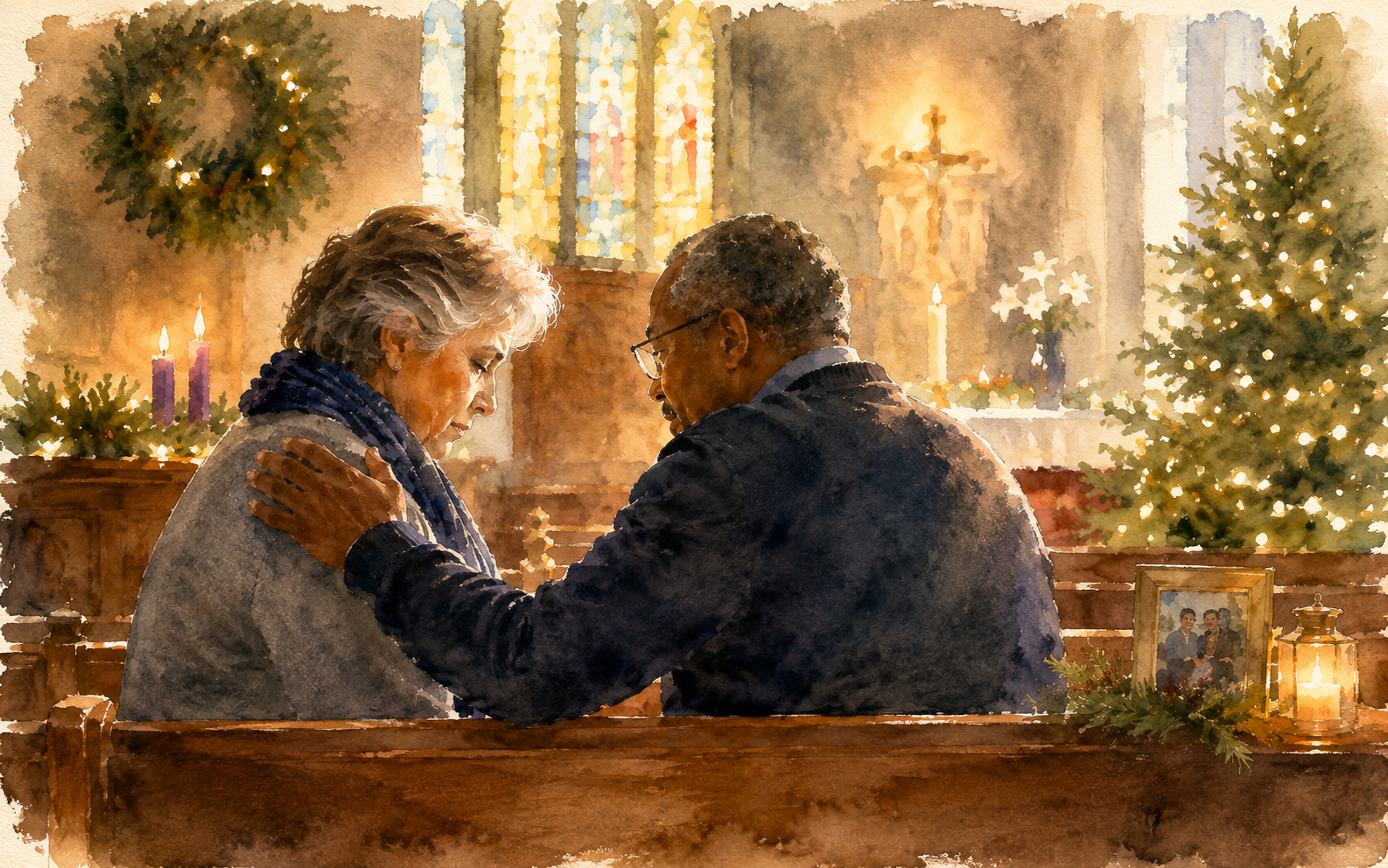
Every Sunday there are members in your churches who do not feel “merry, happy, or bright.” Within your weekly gathering grieving congregants try to put on their “game face” to worship with you. The “game face” accompanies their response of “I am fine” when fellow congregants ask, “How are you?” Afraid no one will understand their grief; they shroud themselves with the mask of “I am fine.” Fearful that their lament will disrupt “The Happiest Time of the Year” for their faith community, many of your congregation grieve quietly alone.
Grieving members of your congregation during the holiday season are confronted by mile markers and triggers. For many, a mile marker – or several mile markers – may be the first Thanksgiving and Christmas encountered since the passing of their loved one. The first Christmas without a wife. The first Thanksgiving without their mother. “Who will carve the turkey or the ham since dad died this year.”
Triggers, like landmines in a warzone, invade “the most wonderful time of the year.” A wife walks into a room and smells a scent like her deceased husband’s cologne. An adult child walks into the family home for the first time since the passing of a parent. Triggers, unlike mile markers, cannot be anticipated. They strike with no warning.
How is a church to respond? What is an appropriate way for church leaders to step into the grief of their parishioners? Should everyone don sackcloth and ashes every Sunday of Advent? Obviously, we should not. Our grieving members do not want that for everyone even when sackcloth might be comfortable on them.
The intent of this article is to provide church leaders and caring congregants with a model for giving bereaved congregants a space to lament and remember their loved ones. This model is not the only way to come alongside grieving church members. This template is a way to acknowledge the grief which for some accompanies the holidays. It has been meaningful for some grieving congregants of churches I have served in Arlington, TX; Topeka, KS; and Mansfield, TX. As with any model or template, each church implementing Making It Through the Holidays needs to make it their own.
Invitation
Each congregation will need to find the best way to extend an invitation to Making It Through the Holidays and to a Day of Remembrance. Here are the practices I have used for extending an invitation:
- Churches in which I extended an invitation to Making It Through the Holidays began keeping a spreadsheet of congregants experiencing a death.
- We maintained a list of deaths of family members from the current November through the following October.
- In mid to late October an invitation personally signed by me would be sent via USPS to everyone on our spreadsheet.
- A day or two after the letter should have arrived, an email including an invitation was sent to the same group.
- The following Sunday, congregation-wide communication would begin. I was cognizant that not everyone experiencing a loss would have been known by the church staff.
- All three invitations included these two events, Day of Remembrance and Making It Through the Holidays.
Day of Remembrance
Originally, this was the last part of Making It Through the Holidays. In the last session the gathered grievers would corporately grieve the loss of their loved ones. This session would be the most worshipful of the sessions. Singing, prayers, scripture reading, candles, and a message of comfort provided the structure for the last session.
Over time the Day of Remembrance became a part of the Sunday evening worship service. Eventually, the Day of Remembrance found its place in a Sunday morning assembly. The most recent rhythm has found the Day of Remembrance in a Sunday morning service prior to the launch of Making It Through the Holidays for that holiday season. The songs are selected with a balance of laments and hymns of hope. Appropriate prayers and scripture readings are included as is a message of comfort. The message of comfort is slightly longer when included in the worship service.
A roll call of those who have died since the previous Day of Remembrance has been added. The congregation is invited to stand. The minister invites those who have lost a loved one to be seated in groups. The order of groups being seated is based on the type of relationship they had with the deceased. For example, the minister will say, “If you have lost your spouse in the last year, please be seated.” The minister will have each group seated based on the perceived closeness of the lost loved ones. The roll call is concluded by saying, “If you experienced a significant loss in the last year not mentioned, please be seated. For the past decade, grieving parishioners have comprised one-half to three-quarters of the congregations in which I have ministered. Congregants still standing are invited to find a seated brother or sister to place their hand on their shoulders. An elder then is invited to pray for those who are seated, those who have experienced a loss in the last year.
During the service, those who are grieving are given an additional invitation to participate in Making It Through the Holidays.
Making It Through the Holidays
In the three congregations I mentioned earlier, we had to experiment to find what was the best time to meet. In Arlington it was on Wednesday nights. In Kansas we finally decided upon Sunday mornings during class time. Making It Through the Holidays in Mansfield was held on Sunday afternoons. Likewise, through experimentation, I discovered the rhythm of having two meetings prior to Thanksgiving, taking the week of Thanksgiving off, concluding with two weeks following Thanksgiving seemed to be most helpful. As we look at a brief overview of the sessions’ content you may begin to see the value of this rhythm. Speaking of content, it has also evolved through the years.
Weekly Content
The content described below is the content I am currently using. I am continually looking for additional resources. Each week resources are shared, and some are given to participants to take home. A brief bibliography of these resources can be found at the end of this article.
Week One
During the first session, expectations are discussed. Categories of content are disclosed: education component regarding grief, a time for each participant to share about their grief and their loved one, discussions of what the holidays will look like without our loved one, homework for the next session, and a time of prayer. Ground rules for sharing time, including expression of emotions, are established. The group agrees upon a signal the facilitator can use when someone needs to allow the next person to share with the group. The group is informed concerning the normalcy of emotions which will be expressed even if they differ from my emotions.
The introduction time is followed with a prayer. After the prayer, as facilitator, I calmly encourage the participants to know their grief is theirs. The way they express grief will be different from others in the group. Though their grief may not feel normal, it is a normal response to loss. The loss they are grieving has never happened before. Therefore, it feels abnormal but isn’t given the loss of their loved one. I include this quote attributed to John Pavlovitz, “Grief is the tax on loving people.” I sent them home with an article written by Pavlovitz.
This education piece is followed by a time of group sharing. I ask each member to tell us something about who they are grieving. I ask, “Who in your life are you currently grieving?” Each participant is given an opportunity to share.
We follow the sharing time with a discussion regarding triggers to our grief and mile markers. Primarily, I want to reinforce that we can anticipate mile markers while triggers sneak up on us. Mile markers are events; marriage anniversaries, birthdays, holidays. Most who attend Making It Through the Holidays are working through the first time to cross the mile markers of Thanksgiving and Christmas without their loved one.
Triggers ambush us. Triggers are anything that triggers a memory of our loved one, launching our grief. For example, a smell can quickly trigger a memory of a loved one and launch us into our grief. Another common trigger is seeing someone who looks like our loved one.
Once we have discussed triggers and mile markers, homework is assigned. The homework for week two asks each person to share their plans for Thanksgiving with the group. Each participant is invited to bring a meaningful object associated with their loved one. (One year I took hunting boots, the year I was grieving my father’s death. We hunted together since my childhood.) We conclude with prayer. Per availability, I like to ask a different elder to attend each session. When an elder is in attendance, I ask him to lead the closing prayer.
Week Two
Week two begins with a reminder of the session ground rules followed by a prayer. During week two, we review and conclude the discussion regarding triggers and mile markers. The group reads John 11:17-46 regarding the illness, death, and resurrection of Lazarus. The text is read as a script with group members being the actors. The subsequent discussion debunks the often-heard myth, “it is unchristian to grieve.” Though individuals in the Bible did not all grieve the same, they were never told not to grieve.
The devotional reading is followed with group members’ “show and tell” of the objects associated with their deceased loved one. After “show and tell,” group members are asked to share their plans for the holidays. Often a participant will share that they do not wish to continue a holiday tradition, while another may wish to continue one. I reinforce the appropriateness of new traditions or keeping long held traditions in celebrating the holidays. We close with prayer. I offer each group member a copy of H. Norm Wright’s book, Experiencing Grief.
Week Three
The beginning of week three resembles the beginning of week two. Following a reminder of the ground rules, prayer, and a review, we discuss the stages of grief originated by Dr. Elizabeth Kubler-Ross. Each participant is given a handout with the five stages. After an explanation of each stage of grief, the participants are encouraged to identify which stage they are in. Next group members are given a card entitled, Ball of Grief: A Tangled “Ball” of Emotions. (See resources below.) The Ball of Grief is then compared to the five stages of grief. Participants are then asked, “Which better represents your experience with grief: a ball of emotions or five stages? In asking this question, I have never had someone choose the stages of grief.
Participants then share their Thanksgiving experience. My experience is during week two or week three, the participants begin to provide compassionate care for each other. Often supporting each other outside of our meetings together. Along with the laminated Ball of Emotions card, the group members are offered a book entitled, Good Grief. The session is concluded with prayer.
Week Four
Hospitality plays an important role in Making It Through the Holidays. At each church, the meetings were held in the most inviting and hospitable room in the building. (Parlor, Living Room, etc.) Each week hot beverages and snacks are provided. During this last session, we provide popcorn and M&M’s. (Don’t judge—I like M&M’s in my popcorn.)
Popcorn is provided to accompany the concluding sessions video, Tear Soup. In the previous three sessions, I promote week four as the session they do not want to miss. After opening with prayer, a brief check-in, and everyone getting their popcorn, we begin the video. The video is an adaptation of the children’s book by the same name, Tear Soup. Spoiler alert, Tear Soup, is a metaphor for grief. After watching the video, everyone is allowed to share images in the video which mirror their own grief experience. The session is concluded with a prayer. Normally, the group stays for some time visiting and reflecting upon the experience, which is organic.
Conclusion
Throughout this article, we have referred to Making It Through the Holidays as a template. Congregations wanting to incorporate it into their annual rhythm need to make the template their own. I would be glad to assist your congregation launching your own Making It Through the Holidays. Feel free to contact me with questions. I would be glad to provide session outlines and order for Day of Remembrance services. You can contact me at tkitson@lifelinechaplaincy.org.
Resource Bibliography
Week One
Pavlovitz, John. https://johnpavlovitz.com/2019/08/24/grief-is-the-tax-on-loving-people/
Week Two
Wright, H. Norman. Experiencing Grief. Brentwood: B&H Publishing, 2004.
Week Three
Westburg, Granger E. Good Grief: A Companion for Every Loss. Minneapolis: Fortress Press, 2019.
Wright, H. Norman. https://www.hnormanwrightstore.com/Ball-of-GriefExperience-Grief-counseling-card_p_43.html
Week Four
Tear Soup DVD. https://griefwatch.com/collections/tear-soup-home/products/tear-soup-dvd
Tear Soup Handouts. https://cdn.shopify.com/s/files/1/0268/5544/0576/files/Tear_Soup_Cooking_Tips.pdf?v=1604616351